Coating of a Sand-Blasted and Acid-Etched Implant Surface with a pH-Budering Agent after Vacuum-UV Photofunctionalization
Abstract: Ultraviolet (UV) photofunctionalization can reset the biological aging of titanium after
the preparation and storage of dental implants by transforming hydrophobic titanium surfaces into
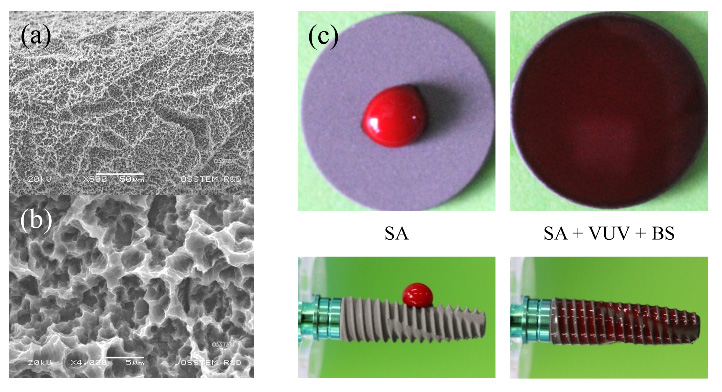
superhydrophilic surfaces. Blood clot formation around the implant can initialize and promote the
healing process at the bone–implant interface. The aim of this study is to evaluate and compare the
capabilities of surface wettability and blood clotting of implants with a conventional sand-blasted
and acid-etched surface (SA), a sand-blasted and acid-etched surface with vacuum-UV treatment
(SA + VUV), and a sand-blasted and acid-etched surface coated with a pH-bu ering agent after
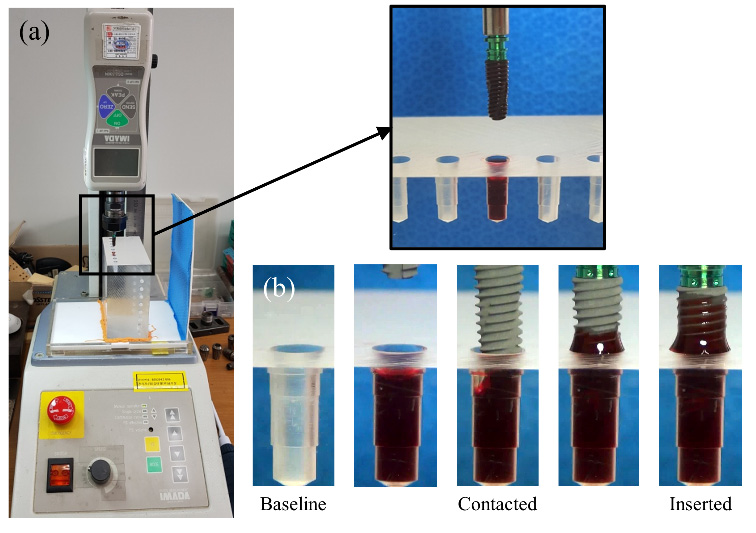
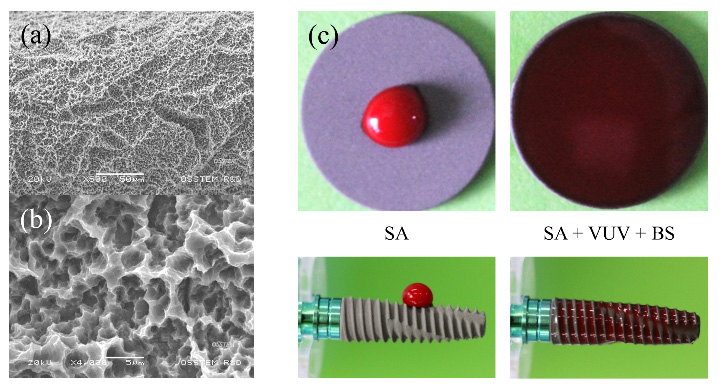
vacuum-UV treatment (SA + VUV + BS). Static and dynamic tests for surface wettability and blood
clotting were performed in vitro for SA + VUV and SA + VUV + BS (n = 5), while hemostasis
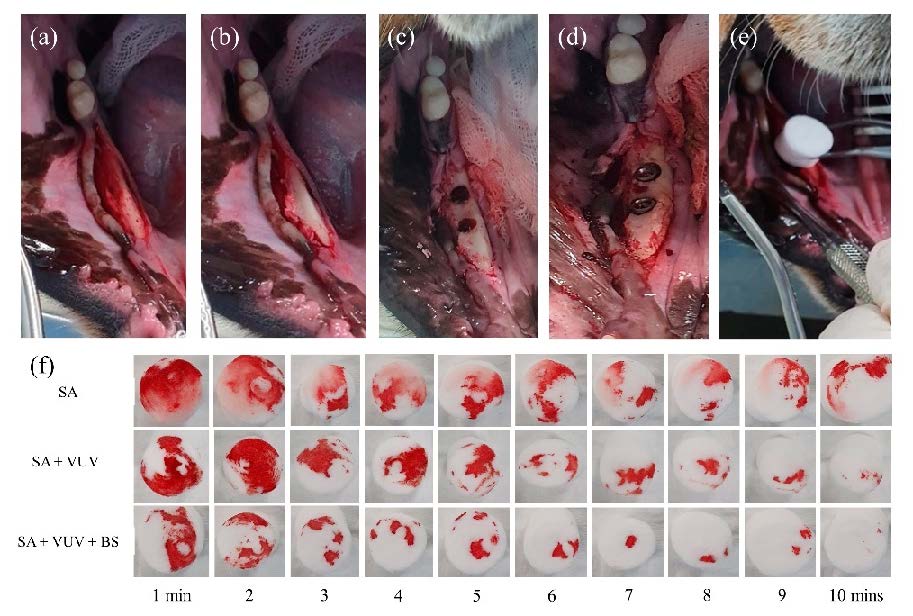
resulting from blood clotting was evaluated in vivo for SA, SA +VUV, and SA + VUV + BS (n = 4).
A Kruskal–Wallis test showed statistically significant di erences (p < 0.05) in all tests, with the
exception of in vitro test of static blood clotting. VUV treatment is therefore e ective at making an SA
surface superhydrophilic as an alternative to routine UV-C radiation. The addition of a pH-budering
agent to SA + VUV also improved surface wettability and blood clotting, which are crucial for
successful osseointegration.
Galería